Industry Updates
For Mediation Institute Members and other Dispute Resolution Professionals
Recent Posts

#IMAW25 | Explore How Mediation Builds Understanding and Harmony
Weβre not limiting the power of mediation to one week, weβre celebrating it all month long! Join IMAW25 this November and uncover how mediation helps people find peace through understanding.

How do I keep track of my professional development?
Professional Development obligations for Mediators and FDR Practitioners in Australia. How to keep track of your ongoing professional development obligations

Acknowledgement of Country
Find out more about Acknowledgement of Country, Reconciliation and Cultural Safety resources.
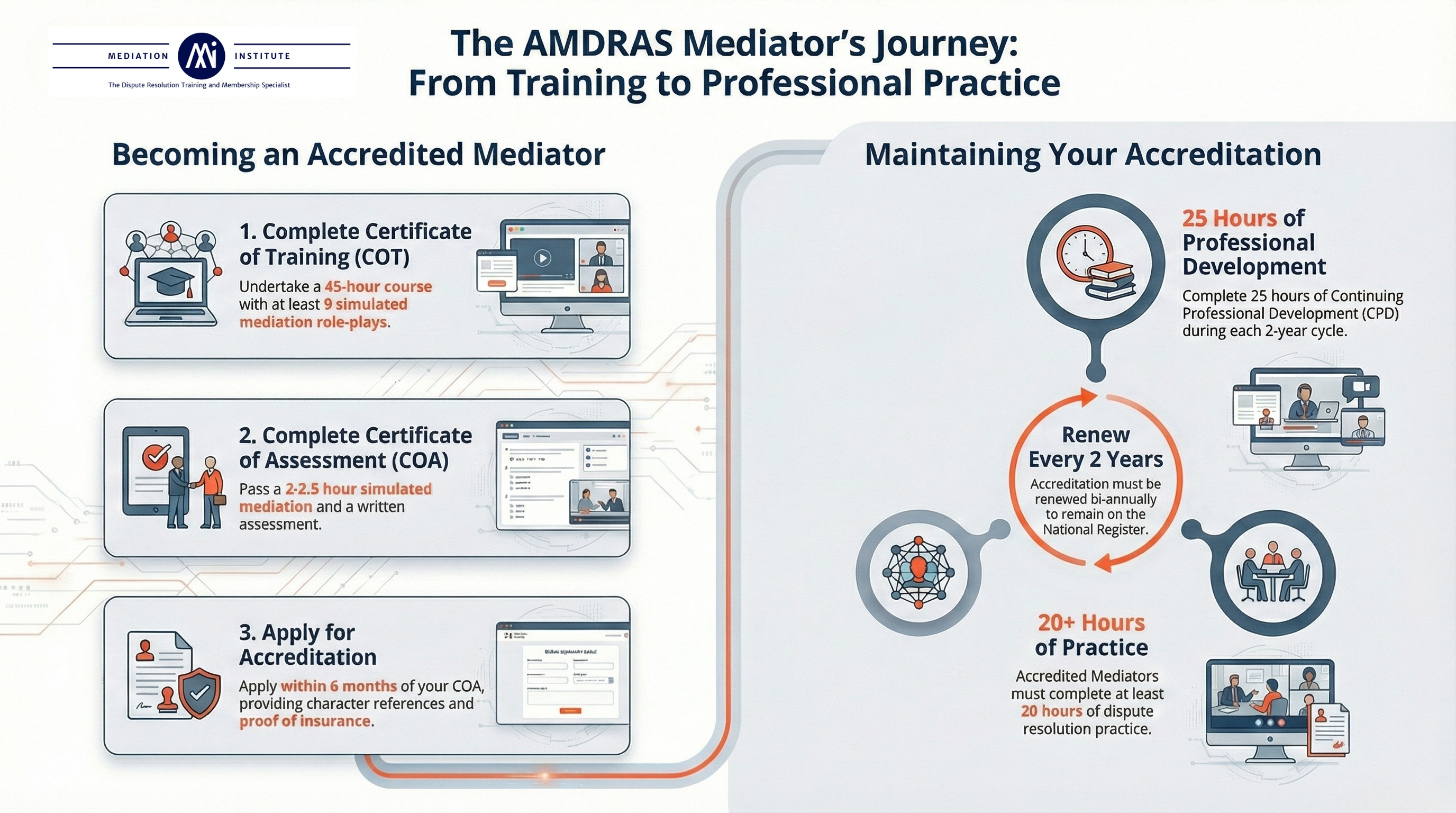
Your Path to Becoming an AMDRAS Accredited Mediator: A step-by-step Guide
A step by step guide to becoming an amdras accredited mediator

Navigating Mandatory FDR: Insights from 2024 – 2025 Family Court Case Law for FDRPs.
Recent Australian cases mentioning family dispute resolution and their significance for mediators (January 2024 β November 2025) This summary identifies recent Australian cases

Streamlining Your Accreditation: The AMDRAS Alternative Pathway for FDR Practitioners
Discover the AMDRAS Alternative Pathway for FDR Practitionersβstreamlining accreditation and recognising your existing expertise in family mediation.
Catch up with On Demand CPD
The 4 Pillars of Mediation with David Mitchell
The model recognises that ...mediation competence extends beyond process knowledge and is shaped by four interconnected foundations:
- Philosophy, the principles and ethical beliefs guiding practice;
- Psychology, an understanding of the emotional and behavioural dynamics present in conflict;
- Persona, the mediators' professional presence and how they are experienced in the room; and
- Present, a disciplined focus on the "here and now" of the dispute.
Together, these pillars support both mediators' personal and professional development and foster meaningful peer discussion of practice.
Timestamps:
0:06 β Introduction & David Mitchell's background
14:04 β Pillar 1: Philosophy β Aristotle, compassion vs. empathy, and practical wisdom
14:11 β Pillar 2: Psychology β The mediator as conductor, mirror cells, NLP & person-centred communication
21:42 β Pillar 3: Persona β Professional presence, self-compassion, peer supervision & oxytocin
26:47 β Pillar 4: Present β Working in the now, hippocampal shifts & Gestalt cycles
34:28 β Q&A β Discussion & audience questions
41:12 β Are mediators born or made?
46:33 β Aristotle's 12 virtues explored
Members can connect with David via the members portal #mediation #mediationinstitute #reflectivepracticeShow More

The model recognises that ...mediation competence extends beyond process knowledge and is shaped by four interconnected foundations:
- Philosophy, the principles and ethical beliefs guiding practice;
- Psychology, an understanding of the emotional and behavioural dynamics present in conflict;
- Persona, the mediators' professional presence and how they are experienced in the room; and
- Present, a disciplined focus on the "here and now" of the dispute.
Together, these pillars support both mediators' personal and professional development and foster meaningful peer discussion of practice.
Timestamps:
0:06 β Introduction & David Mitchell's background
14:04 β Pillar 1: Philosophy β Aristotle, compassion vs. empathy, and practical wisdom
14:11 β Pillar 2: Psychology β The mediator as conductor, mirror cells, NLP & person-centred communication
21:42 β Pillar 3: Persona β Professional presence, self-compassion, peer supervision & oxytocin
26:47 β Pillar 4: Present β Working in the now, hippocampal shifts & Gestalt cycles
34:28 β Q&A β Discussion & audience questions
41:12 β Are mediators born or made?
46:33 β Aristotle's 12 virtues explored
Members can connect with David via the members portal #mediation #mediationinstitute #reflectivepracticeShow More

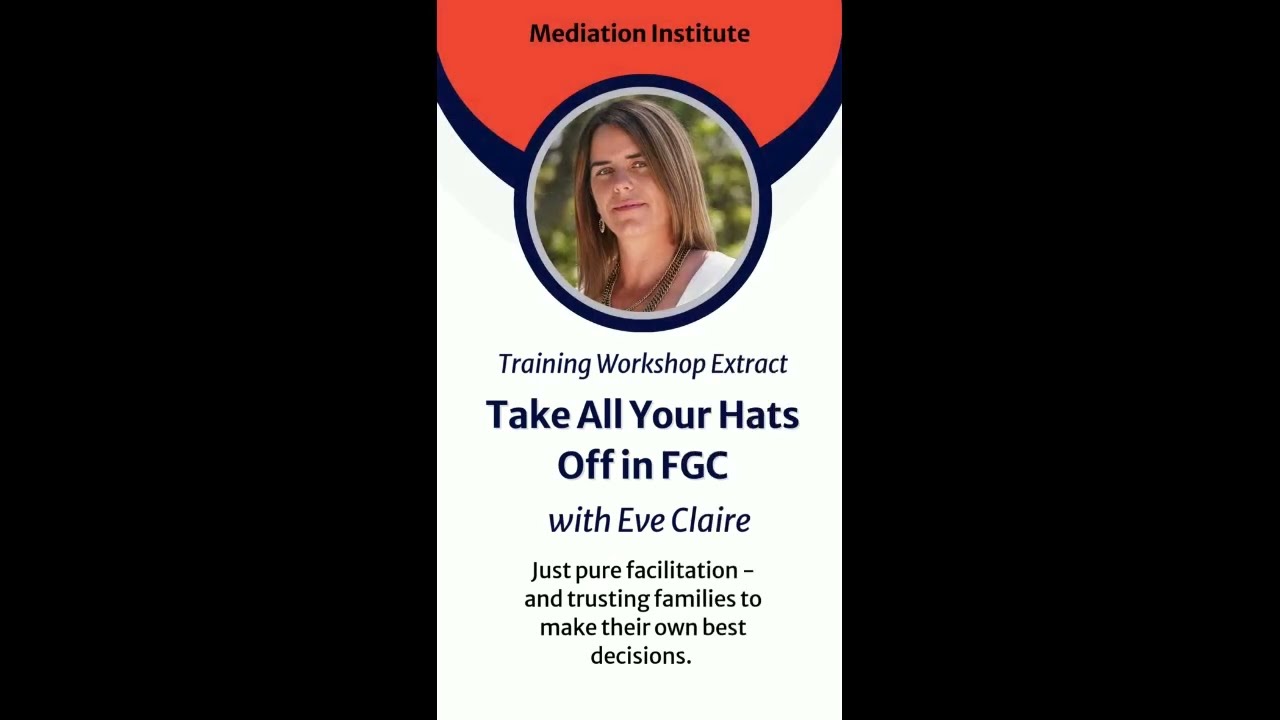
But according to experienced FGC facilitator Eve ...Claire, that's rarely what happens β and it comes down to two things: sticking to the principles and preparing well.
In this extract from a Mediation Institute training session, Eve explains how thorough preparation builds trust, and how trust in the room is what makes facilitation flow.
π Want to learn how to facilitate Family Group Conferences? Visit http://www.mediationinstitute.edu.au and search for Family Group Conferencing.
π Like and follow for more short extracts from Mediation Institute training sessions.
Suggested hashtags:
#FamilyGroupConferencing #FGC #MediationInstitute #FacilitatorTraining #ConflictResolution #SocialWork #ChildProtection #RestorativeJustice #FamilyServices #ProfessionalDevelopmentShow More

Topics covered include the codified four-step property framework, the new express provisions for family violence in contributions and current/future circumstances, the statutory duty of disclosure now written into the Act, and the new category for companion animals.
Note: The member discussion portion of this webinar has been edited out of this recording. A full version is available to members in the CPD library. http://www.mimembers.au
π Like, subscribe and hit the bell for more FDR education and family law updates.
β±οΈ Timestamps:
0:00 β Welcome & introduction
0:58 β Housekeeping & session format
1:37 β Acknowledgement of Country
2:47 β Webinar overview: what we'll cover
4:41 β The four-step property framework (now in the Act β s.79(3))
5:21 β Family violence provisions: contributions & future circumstances
7:13 β Duty of disclosure: moved from Rules into the Act
8:35 β Companion animals: a new category (not just chattel)
9:06 β Add-backs: what's changed with current case law
14:20 β Step 1: Legal & equitable interests, asset identification
16:01 β Step 2: Contributions (financial, non-financial & family violence)
17:32 β Step 2 cont.: The family violence contribution lens
19:51 β Step 3: Current & future circumstances (s.79(5) factors)
25:28 β Housing & care of children: now an explicit factor
31:42 β Other s.79(5) factors: education, earning capacity, cohabitation
35:22 β Family violence: landmark case & the high bar that existed
37:05 β How the amendments have lowered that bar
43:33 β Duty of disclosure: key cases & practical implications
50:55 β s.71B: Our statutory obligation as FDRPs
55:58 β Managing disclosure: pre-mediation & during sessions
1:02:50 β When to stop the process: non-disclosure & financial abuse
1:10:02 β Companion animals: court orders, shared care & intake tips
1:23:07 β Key takeaways & CPD wrap-upShow More

In ...this extract from a Mediation Institute training session, FGC trainer Eve Claire explains one of the most liberating aspects of facilitation: your job is simply to bring everyone to the table fully prepared, then get out of the way. No advice-giving. No suggestions. No directing outcomes.
Just pure facilitation β and trusting families to make their own best decisions.
π Ready to become a Family Group Conference facilitator? Visit http://www.mediationinstitute.edu.au and search for Family Group Conferencing.
π Like and follow for more short extracts from Mediation Institute training sessions.Show More

In this extract from a Mediation ...Institute training session, experienced FGC facilitator Eve Claire shares a counterintuitive truth: when you trust the model and prepare well, families lead themselves. You don't need to keep detailed case notes. You don't need to be a counselor, a support worker, or a psychologist.
You just need to facilitate the process β and get out of the way.
π Want to learn how to facilitate Family Group Conferences? Visit http://www.mediationinstitute.edu.au and search for Family Group Conferencing.
π Like and follow for more short extracts from Mediation Institute training sessions.
#FamilyGroupConferencing #FGC #MediationInstitute #FacilitatorTraining #SocialWork #ChildProtection #RestorativeJustice #FamilyServices #LessIsMore #ProfessionalDevelopmentShow More

"Future focused" β it sounds simple, but it's a powerful tool in your facilitation toolkit.
In this extract from a Mediation ...Institute Family Group Conferencing training session, trainer Eve Claire explains why keeping families future-focused is your best friend as a facilitator β and how it reduces conflict, eases anxiety, and empowers families to create their own plan.
When families understand that the conference isn't about rehashing the past, they show up differently. And when they start holding each other to that principle in the room? That's when you know you're facilitating well.
π Interested in becoming a Family Group Conference facilitator? Visit https://www.mediationinstitute.edu.au/family-group-conference-facilitator-training/
π Like and follow for more short extracts from Mediation Institute training sessions.Show More

Hello. Today I'm going to show you how to put some content into your profile for our Find a Mediator panel. You're able to add images and content ...about yourself.
0:26 β Example of a great profile
Natalie has added her photo, her logo, a link to her business, an email address, and keywords that identify the type of work she does. This is ideal because it helps people find you on the Find a Mediator page β and it makes it easier for us to refer you.
0:55 β Why a complete profile matters
We tend not to refer people to blank profiles. The link on your profile also allows people to email you directly about work.
1:15 β How to log in and join as a member
If you're not a member, you can join Mediation Institute as a practitioner member. Membership is $190 a year and includes access to all CPD events, courses, and free one-hour CPD sessions for members and students.
3:25 β How to update your profile (About Me section)
Go to My Settings, then navigate to About Me. This is where you update your bio, add qualifications, and enter keywords to help potential clients find you.
4:30 β Adding your logo
Go to My Organisation, click Edit Logo, upload your logo image, and hit save.
5:27 β Finding and sharing your profile link
Once your profile is open, click on Profile Page β the URL will update with your details. Copy that link and use it in your email signature or anywhere you like.
6:23 β Recap
Log in at http://www.mimembers.au β My Settings β About Me. Update your bio, add keywords (specialisations, languages, cultural background), add a photo, and click save.
7:14 β Wrap up
Once you're happy with it, click save. Remember to add a photo. That's all for now β thank you, bye!Show More

In this ...course, you'll:
β Learn practical supervision tools and frameworks
β Connect with peers in supervision circles
β Practice real-world supervision skills
β Gain a pathway to formal recognition
Ready to get started? Find out more - https://www.mediationinstitute.edu.au/supervision-training/
Students Complete these three steps and then start on the self-paced online course materials.
1. Download the Reflective Supervision Companion Guide using the link below or from within the course files.
2. Join our MI Mediators Network supervisor space for collaboration in between scheduled sessions.
3. RSVP for your supervision circle sessions in the Network.
Get ready to grow together with us as a Reflective Practice Supervisor.
#Mediation #DisputeResolution #ProfessionalDevelopment #ClinicalSupervision #ReflectivePractice #MediationInstituteShow More

Perfect for family dispute resolution practitioners, workplace mediators, and anyone seeking to deepen their reflective practice through quality supervision or even personal reflection.
π― What You'll Learn:
β’ Why most case studies stay at surface level
β’ The 6-part structure for reflective case studies
β’ How to identify and explore ethical tensions
β’ Strategies for examining your internal decision-making
β’ Common pitfalls to avoid in case study preparation
π Resources:
β’ Free case study preparation tool for Mediation Institute Members
β’ Introduction to the Seven Eyes supervision model
β’ Tripod Model for balanced supervision
β±οΈ TIMESTAMPS
0:00 Introduction & Acknowledgement
0:58 What's Hardest About Case Studies
3:23 Why Case Studies Stay Superficial
4:56 Example: Superficial Case Study
6:09 Supervision Questions
7:42 How to Design a Case Study
8:12 Professional Supervision Overview
9:25 Supervision Ready Case Study Elements
11:00 Reflection as Risk Management
11:33 Six Part Structure Tool
14:19 Detailed Example - Context
16:01 Detailed Example - Process Decision
16:20 Detailed Example - Ethical Tension
16:37 Detailed Example - Internal Experience
17:21 Detailed Example - Questions
19:07 Group Discussion
28:19 Tripod Model Introduction
29:27 Seven Eyes Model
31:05 Common Ethical & Reflective Pitfalls
38:47 Recap & Key Takeaways
40:18 Q&A - Supervisor Course
π Related Links:
https://www.mimembers.au/links
https://www.mediationinstitute.edu.au/supervision-training/
π’ About This Webinar:
Presented by the Mediation Institute, this webinar provides practical guidance for mediators and family dispute resolution practitioners seeking to maximize the value of professional supervision.
Mediation #ProfessionalSupervision #CaseStudy #FDR #ReflectivePractice #MediationTraining #ProfessionalDevelopmentShow More

The video by Mediation Institute Director, Joanne Law provides a quick orientation to Mediation Institute systems and study processes, including ...how to log into the learning management system at mi.study247.online, create a free account, or reset a password, and where to find enrolled courses on the dashboard.
It explains recommended course order (starting with the Student Hub and βOperate in a Family Law Environmentβ), clustered core and elective units, and how to adjust notification preferences and add a profile picture. It also introduces the separate membership site (www.mimembers.au) for free student access to events and recordings via a manual approval process, and the Mediation Institute Network collaboration spaceβespecially the FDR students hubβfor connecting with other students, role plays, event links, and questions.
Contact options for student support, orientations, and assignment help are provided.
00:00 Welcome and Overview
00:10 Course Login Setup
01:07 Dashboard and Course Tiles
02:47 Notifications and Profile
04:25 Member Site and Events
05:39 Support Contacts and Access
06:00 Network Collaboration Space
07:13 Student Hub and Role Plays
07:50 Wrap Up and Next StepsShow More

In this comprehensive webinar, Joanne Law, Director of Mediation Institute, clarifies ...the professional boundaries, obligations, and key differences between FDR practitioners under the Family Law Act and nationally accredited mediators under AMDRAS standards.
π What You'll Learn:
β Why jurisdictional distinction matters for your practice
β Statutory obligations for FDR practitioners vs AMDRAS mediators
β Child focus, safety, and suitability assessment requirements
β Section 60I certificate authority and responsibilities
β Confidentiality and inadmissibility protections
β Registration pathways and accreditation requirements
β Professional development obligations (24-25 hours every 2 years)
β Record-keeping requirements (updated 2025 regulations)
β Common complaints and how to avoid them
β Decision-making framework for determining FDR vs general mediation
β±οΈ Chapters:
0:00 Introduction & Acknowledgment
2:00 Why Jurisdictional Distinction Matters
4:06 Overlap Between FDR and AMDRAS
7:25 What Changes When It's FDR
11:03 Jurisdictional Triage
14:10 AMDRAS vs FDR Systems Comparison
25:49 FDR Obligations Under Family Law Act
29:51 Summary of Key Differences
36:01 Decision Making Framework
37:19 Insights from Complaints
42:00 Closing Remarks
π Presented by:
Joanne Law, Director of Mediation Institute and Manager of the approved complaint handling service for nationally accredited mediators and FDR practitioners. http://www.mediationinstitute.edu.au
π Key Updates Covered:
- Family Law (Family Dispute Resolution Practitioners) Regulations 2025
- Updated Section 114B (formerly Section 117) cost provisions
- New record-keeping requirements
- Alternative pathways for AMDRAS accreditation
π Resources Mentioned:
AMDRAS Board: http://www.amdras.au
Australian Institute of Family Studies: https://aifs.gov.au/resources/resource-sheets/mandatory-reporting-child-abuse-and-neglect
Mediation Institute: http://www.mediationinstitue.edu.au for training information. http://www.mimember.au for professional membership information
β οΈ Important for Practitioners:
If you only have core units and rely on AMDRAS accreditation for FDR registration, your FDR status is conditional on maintaining national accreditation. Don't let it lapse!
π¬ Questions or Comments?
Share your thoughts below or contact Mediation Institute for more information.
π§ Want the Decision Tree Document?
Email us at office@mediationinstititute.edu.au to request a copy.
#FamilyDisputeResolution #FDR #Mediation #FamilyLaw #AMDRAS
Β© Mediation Institute
This presentation is for educational purposes. Always consult current legislation and seek professional advice for specific situations.Show More

This short from Mediation Institute summarises the importance of summaries in the Mediators Skill Set.
A summary is ...a concise presentation of the key points, insights or conclusions drawn from a larger discussion.
In mediation it is not a simple retelling and it is never without purpose.
Mediators listen for the hidden gems in the conversation. The competing priorities. The Underlying Interests. The Values Conflicts. The Key Facts. The Hidden Needs. The Emotional Signals. The Potential Options. When Agreement is Possible.
Mediator Summaries then highlight these hidden gems which often get obscured or lost in the flow of conversation.
The role of the mediator is to provide clarity. We shine a light with our summaries and help the parties see what matters most to them. Our summaries keep discussions productive.
Next time you mediate listen carefully and bring the hidden gems into focus with concise summaries.
What insights do you have about summaries?
Share an example of a time when a summary you did brought a hidden gem to the surface and changed the dynamic of a mediation process.Show More